Umayyad Mosque, Damascus: History, Architecture and Spiritual Significance
Few buildings on earth have stood at the center of prayer for as long as the Umayyad Mosque in Damascus. Built at the start of the eighth century on ground that had already served as a place of worship for a thousand years before Islam, it is widely described as one of the oldest mosques still standing in something close to its original form. For a Muslim traveler walking through Old Damascus, this is usually the first stop, and often the one that stays with you longest.
A Site of Worship Long Before Islam
The ground beneath the mosque has a layered history. In ancient times it is said to have held a temple to the Aramaean false-deity Hadad, and later, under Roman rule, it became known as the Temple of Jupiter Damascenus, one of the largest temples anywhere in the Roman East. Some of the outer walls of the mosque today still sit on the old temple's boundary walls, a detail you can spot if you look closely at the masonry from outside.
In 391 CE, the Christian emperor Theodosius I converted the site into a cathedral dedicated to St John the Baptist. When Muslim forces under Khalid ibn al-Walid (RA) took Damascus in 634 CE, the cathedral apparently continued in use for a time, with a section set aside for Muslim prayer, before the Umayyad caliph al-Walid I had it rebuilt entirely as a mosque in the early eighth century. Historical sources differ slightly on the exact completion date, giving either 711 or 715 CE, but there is no real dispute that this was one of the great building projects of the early Islamic world, drawing craftsmen from as far as Persia, India, and the former Byzantine lands.
Inside the Mosque: Mosaics, Minarets, and the Dome of the Eagle
Walk into the courtyard and the scale of the place becomes obvious. The prayer hall runs long and wide behind three tall aisles, crowned at its center by the Dome of the Eagle, rebuilt in an Ottoman style after the original wooden dome was destroyed in a major fire in 1893.
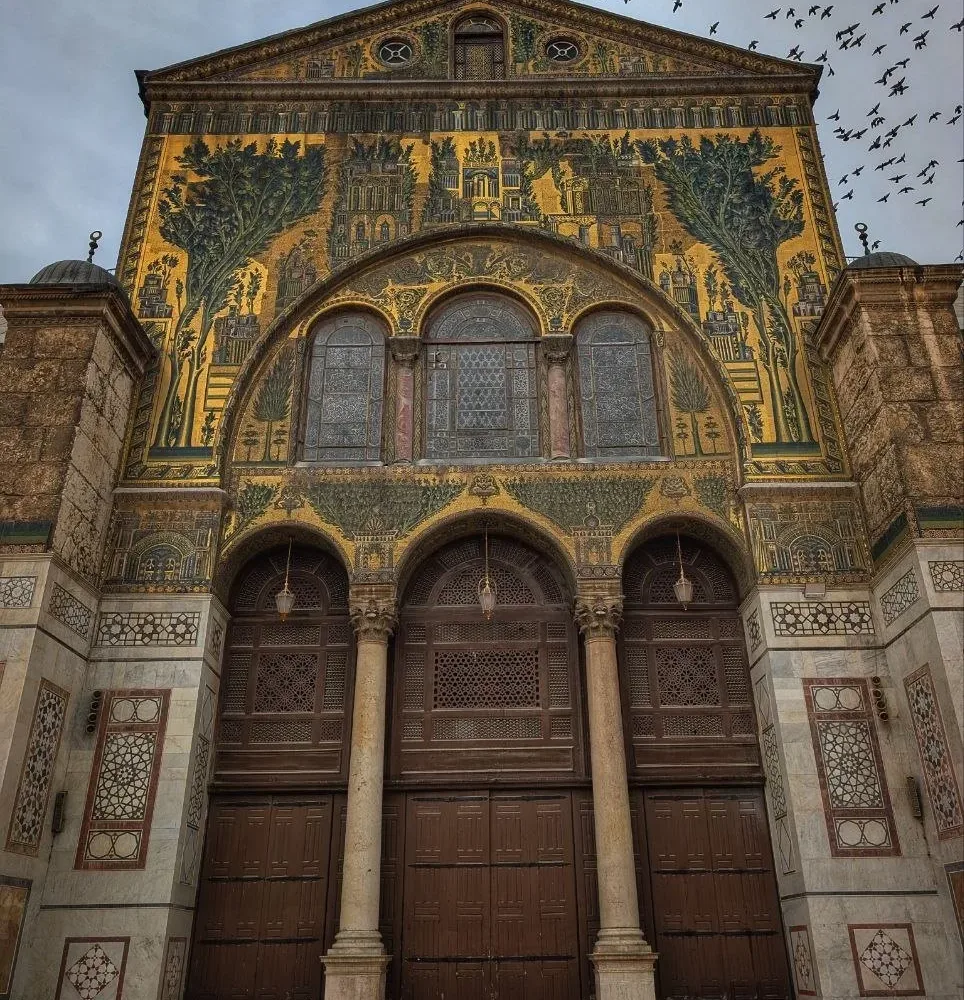
What set the mosque apart from the beginning, though, was its mosaics. At one point an estimated 4,000 square meters of gold-ground glass mosaic covered the courtyard walls, depicting rivers, trees, and idealized buildings rather than human or animal figures, in keeping with the aniconic sensibility of early Islamic religious art. The best-preserved stretch today, known as the Barada Panel, survives largely thanks to a Mamluk-era restoration commissioned by Sultan Baybars in 1270. Historians still debate exactly what the original mosaics were meant to represent, whether specific cities, an idealized Damascus, or a vision of Paradise, and that ambiguity is part of what makes them worth standing in front of for a while.
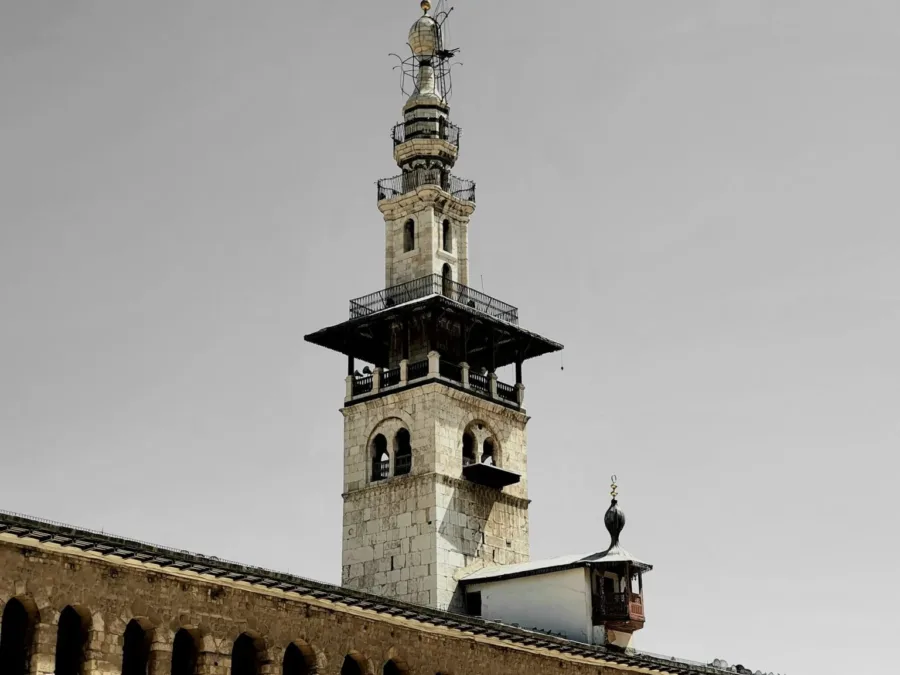
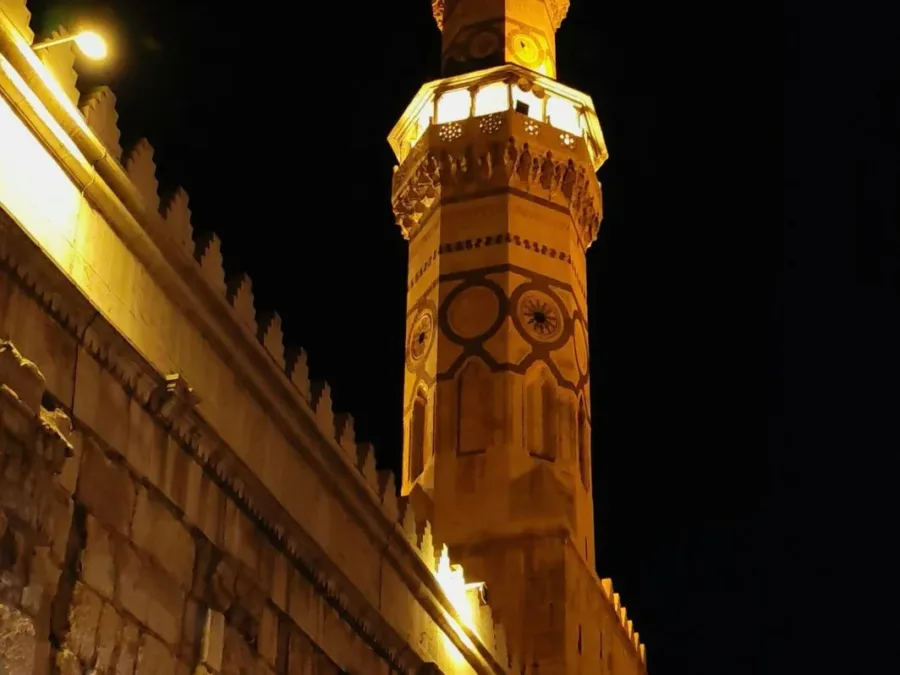
The mosque has three minarets, each with its own story:
- The Minaret of the Bride, on the north wall, whose origins are described differently by different sources, some pointing to an Abbasid-era base rebuilt after a twelfth-century fire, others attributing the original structure to an earlier Umayyad caliph. Historians have not fully settled this point.
- The Minaret of Qaitbay, on the southwest corner, rebuilt in Mamluk style in 1488 after yet another fire.
- The Minaret of Isa, the tallest of the three at roughly 77 meters, on the southeast corner. This is the minaret popularly connected to the hadith describing where Prophet Isa (AS) will descend at the end of days. What that hadith actually says, and what later tradition added to it, is worth reading on its own.
The Shrine of Prophet Yahya (AS)
Inside the prayer hall, a domed shrine holds what tradition identifies as the head of Prophet Yahya ibn Zakariya (AS), known in the Christian tradition as John the Baptist. According to the account passed down through generations, workers discovered a box containing the relic in a cave-chapel during the mosque's original construction, and Caliph al-Walid I had it reinterred beneath a marble-inlaid pillar. This shrine is honored by both Muslims and Christians, a rare point of shared reverence, and it was significant enough that Pope John Paul II visited to pray there in 2001, reportedly the first visit by a pope to a mosque.
Fires, Restorations, and a Long Memory of Survival
The mosque's history since the eighth century reads almost like a record of Damascus itself. It survived fires in 1069, 1173, and 1339, was damaged again when Timur sacked Damascus in 1401, and endured further fires in 1479 and 1893, the last of which was the most destructive in the modern era and led to a nine-year Ottoman restoration. Each time, the mosque was rebuilt, sometimes faithfully and sometimes not, which is why the building you see today is best understood as a long conversation between eras rather than a single, frozen moment in history.
A Popularly Cherished, Though Informal, Ranking
You'll often hear the Umayyad Mosque described as the fourth holiest site in Islam. It's worth knowing that this isn't a formal doctrinal ranking, Islam has clear consensus only on Mecca, Medina, and Jerusalem as the three most sacred sites, and several other places around the Muslim world carry the same informal "fourth holiest" title locally. Think of it as a mark of deep popular reverence rather than an official designation, and the mosque's reputation loses nothing for the clarification.
Visiting the Mosque
Visitors are typically asked to dress modestly, and non-Muslim or female visitors are usually offered a robe to wear over their clothing before entering. Shoes come off at the door. Opening hours and entry arrangements change more often than that, so ask us nearer the time and we will tell you how the mosque is running that week, and which hour of the day gives you the courtyard at its quietest.
Plan Your Visit
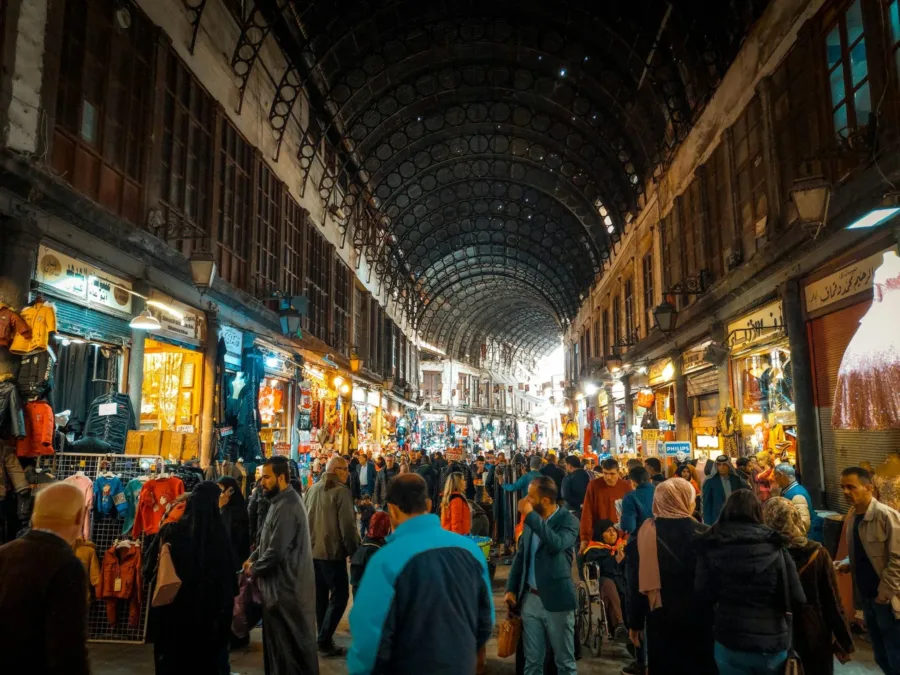
The Umayyad Mosque rewards slow visits. Give yourself time in the courtyard at different points in the day, and pair it with a walk through the Old City and Souk al-Hamidiyah on your way in, and a stop at Saladin's tomb just outside the north wall on your way out.