Al-Zahiriyya Library, Damascus: The Mausoleum and Manuscripts of Sultan Baybars
Near the Umayyad Mosque in the Old City of Damascus stands a building that has served, at different points in its life, as a royal mausoleum, a working madrasa, and for over a century, the closest thing Syria had to a national library. Al-Madrasa al-Zahiriyya carries the memory of one of the Mamluk world's most consequential sultans, and it remains a genuine center of Islamic manuscript scholarship today.
Baybars and the Founding of the Complex
The complex takes its name from Sultan al-Zahir Baybars, who ruled from 1260 to 1277 and is remembered above all for his role at the Battle of Ain Jalut in 1260. It's worth being precise about his role there: at the time of that battle, Baybars was a commander leading the vanguard, not yet sultan, serving under Sultan Qutuz, who held overall command when the Mamluk forces decisively defeated the Mongol army and halted its advance into the Levant and Egypt. Baybars became sultan later that same year, after Qutuz's death.
Baybars died in the summer of 1277, and construction of this complex, intended as his mausoleum, was commissioned that same year, though it may not have been fully completed until around 1281. His son and successor, al-Sa'id Barakah, chose to have him buried near the Great Umayyad Mosque, a deliberate choice of prestige location, and al-Sa'id himself was later buried in the same mausoleum after his own death in 1280. The architect responsible for the building is recorded as Ibrahim ibn Ghana'im al-Muhandis.
The complex was never simply a tomb. It combined two madrasas and a Dar al-Hadith, a dedicated school for the study of hadith, alongside the sultan's mausoleum, all supported through an endowment, or waqf.
Architecture Worth Slowing Down For
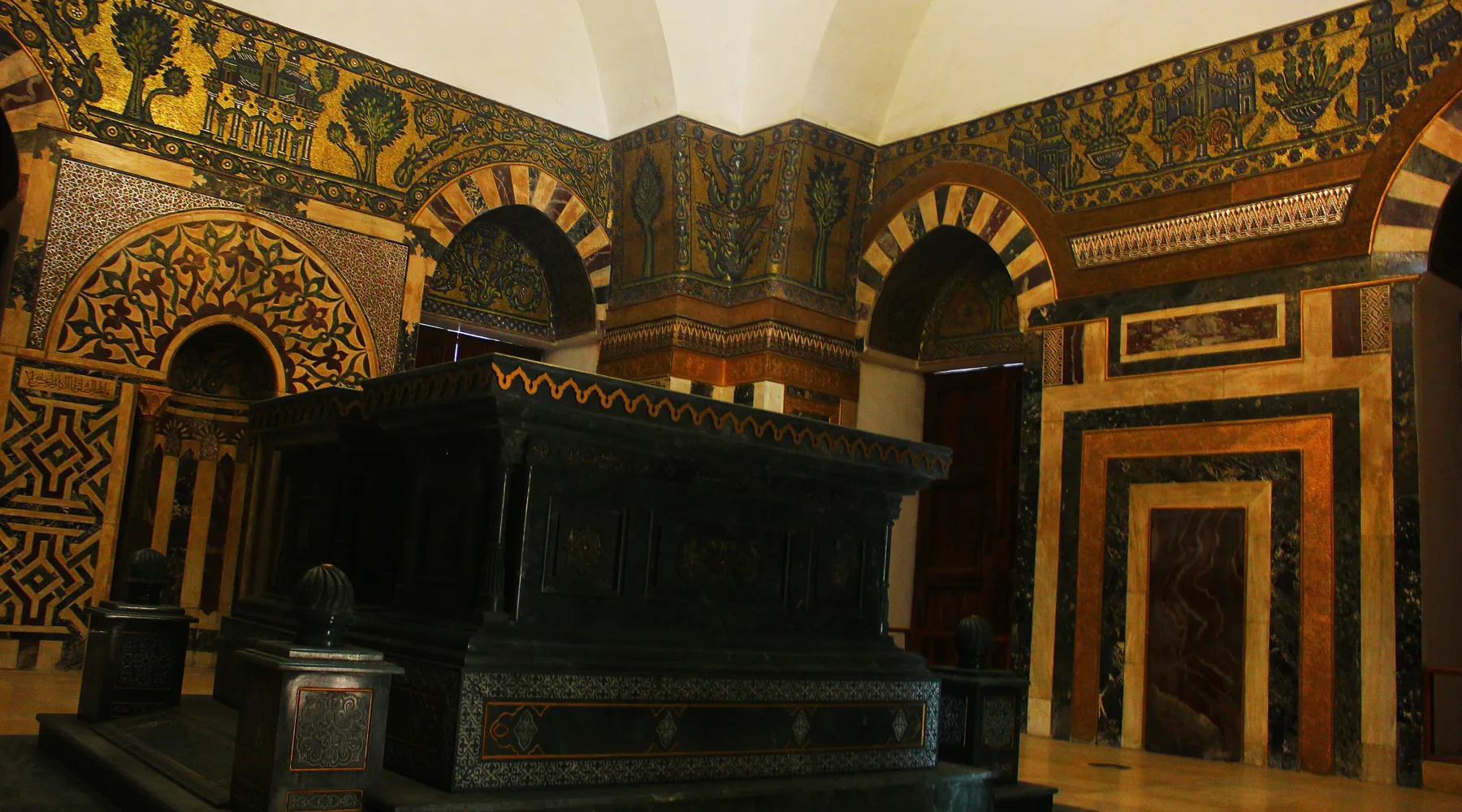
The building's entrance is marked by a monumental portal beneath a broad, carved muqarnas canopy, and its walls carry the alternating light and dark stone courses, known as ablaq, typical of Mamluk architecture. Inside Baybars's own tomb chamber, marble paneling and glass mosaics depicting trees and palaces echo the mosaic tradition of the nearby Umayyad Mosque, a connection that isn't accidental. Baybars himself had sponsored a major restoration of that mosque's mosaics in 1270, so the decorative language in his own mausoleum draws directly on work he had personally funded elsewhere in the city.
A Library That Shaped Islamic Scholarship
The building's transformation into a public library began in the 1870s, opening formally to readers around 1880 to 1881, and for over a century afterward it functioned as Syria's de facto national library, until that role passed to the newly built National Library in 1984.
Its manuscript holdings include genuinely significant early works, among them texts by Ahmad ibn Hanbal and a copy of Ibn Asakir's monumental History of Damascus. By 2011, the collection had grown to roughly one hundred thousand holdings in total, including some thirteen thousand classical manuscripts.
You may also come across the claim that a manuscript by the historian Ibn Khaldun is held at the Zahiriyya. We have not been able to confirm it. What is recorded of Ibn Khaldun in Damascus is that he was lowered by rope over the city walls in 1401 to negotiate with Timur during the siege.
It's also worth clarifying a related point of confusion: the Arab Academy of Damascus, the country's oldest Arabic-language regulatory academy, founded in 1918, is based in the neighboring Adiliyya Madrasa, not inside the Zahiriyya building itself, even though the two Mamluk and Ayyubid-era madrasas sit side by side and are sometimes conflated in casual writing.
Visiting Today
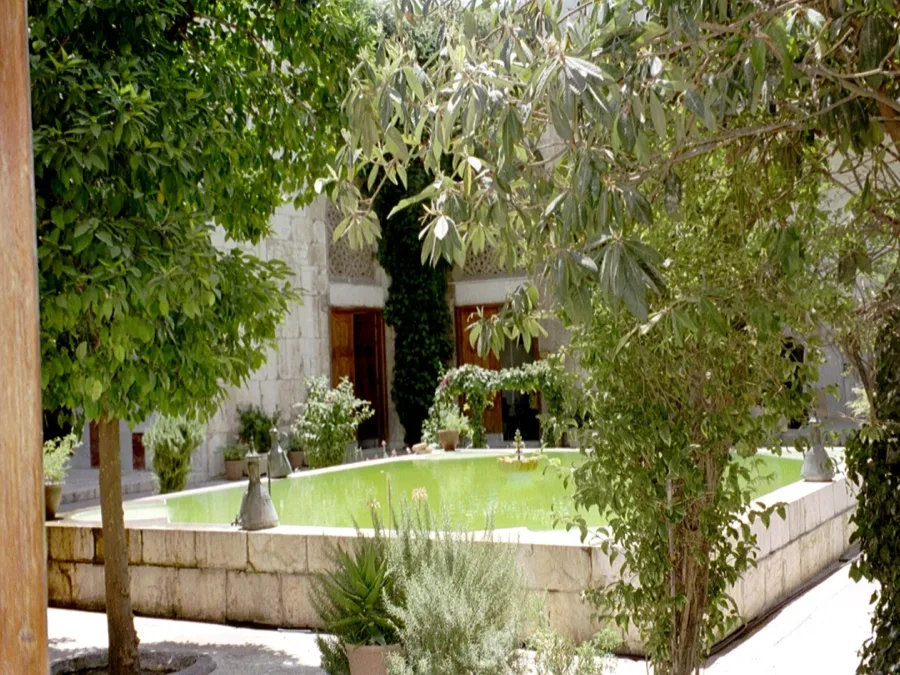
Access to the manuscript reading rooms is generally understood to be restricted to researchers rather than open to casual visitors, though the building's exterior, courtyard, and mausoleum chamber may be viewable depending on current arrangements. As with much of the Old City, the site sits within the boundaries of the UNESCO World Heritage-listed Ancient City of Damascus, which has been on the List of World Heritage in Danger since 2013 due to conservation strain connected to years of conflict. Access here is more restricted than at most of the sites in this journal, so if the Zahiriyya is the reason you are coming, tell us in advance and we will find out what can be arranged.
A Living Link to Islamic Scholarship
For travelers drawn to the intellectual heritage of Islam as much as its architecture, the Zahiriyya offers something distinct: a building where a sultan's tomb, a school of hadith, and a working manuscript collection have coexisted under one roof for well over seven centuries.