The Illuminated Souls of Sham: Shaykh Shukri al-Luhafi
There are souls who teach us that greatness is found not in titles but in quiet service. Shaykh Shukri al-Luhafi was a scholar of deep knowledge who chose to put himself in the service of others, a master calligrapher who lived in a basement room, and a Shadhili guide whose humility is the first thing anyone who met him will tell you about.
Who He Was
He was born in Damascus in July 1920, in the popular quarter of Bab al-Sarija, to a family of modest means. His full name was Shukri ibn Ahmad ibn Ali al-Luhafi, and the name al-Luhafi goes back to the town of Luhaf, between Aleppo and the Turkish border, from where his family had come to Damascus.
By the age of nine he had memorised the Quran. He went on to study at the Faculty of Shari'a in Damascus under a number of the city's teachers, among them Shaykh Mahmud Yasin, Shaykh Arif al-Sawwaf al-Dawaji, Shaykh Mahmud al-Rankusi and Shaykh Muhammad Hashim. He learned the ten canonical readings of the Quran from the reciter Kurayyim Rajih, a teacher he treated with enormous deference although the two were close in age.
The Calligrapher and the Poet
He was also an artist. He studied Arabic calligraphy under masters including Mamduh al-Sharif, Badawi al-Dirani and Hilmi Habab, and became one of the best known calligraphers in Damascus. Mosques commissioned him to write their marble panels, and he trained students of his own in the art.
His hand is still being honoured today. The fine art piece The Glorious Name is drawn directly from one of his own compositions of the name of Allah.
He wrote poetry too, in supplication, in praise of the Prophet ﷺ, in elegy and in wisdom. His collected verse was printed as a diwan, al-Muruj al-Khudr fi Bara'im al-Shi'r, the Green Meadows in the Buds of Poetry, shortly before he died.
A Life of Service
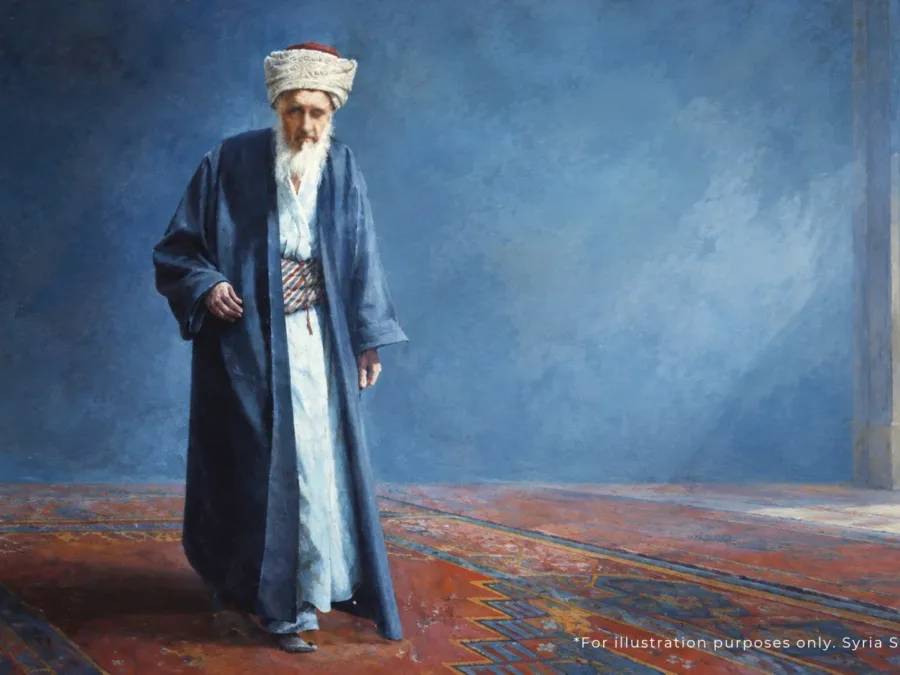
The thing people remember is the humility. Imam Zaid Shakir, who met him after arriving in Damascus in 1994, described a basement apartment no bigger than about five metres by three, with a shower, a toilet and a corner that served as a kitchen. He rode a rugged black bicycle to the mosques, often with children sitting on the crossbar and on a makeshift seat behind him.
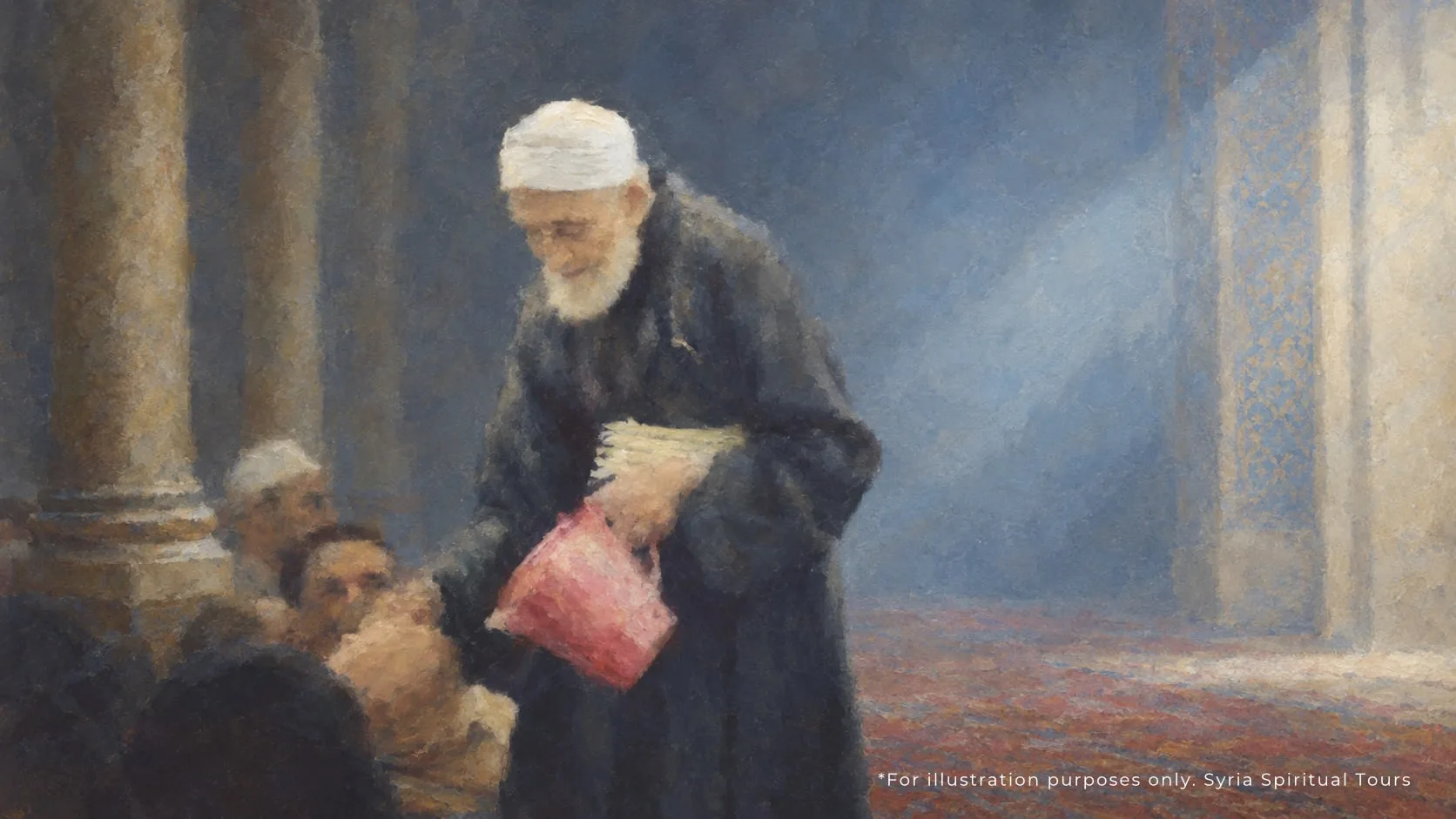
And at the public gatherings of dhikr, he served the water. That was not a gesture made once for effect. It was his chosen work, and he would not let anyone take it from him. Those who knew him called him the Pole of Humility, and it has been said that anyone who wanted to see what the Companions were like need only have looked at him.
There are many stories of the same kind. When he was honoured at a ceremony for the reciters of Damascus in 2006 and given half a kilogram of gold, he gave it away in charity straight away. Asked once to comment on a text in the absence of his teacher, Shaykh Mustafa Turmani, he read the text out word for word, added nothing of his own, and closed the book.
He taught in schools for decades, from 1946 onwards, in Aleppo, Daraa and Damascus, and became a school director recognised by the Ministry of Education for his methods. He never sought position or money, and he refused gifts. After the death of Shaykh Mustafa Turmani he took up the leadership of the Shadhili tariqa in Damascus, having been a student of Shaykh Muhammad al-Hashimi al-Tilmisani and having served in the gatherings of Shaykh Abd al-Rahman al-Shaghouri.
Where He Rests
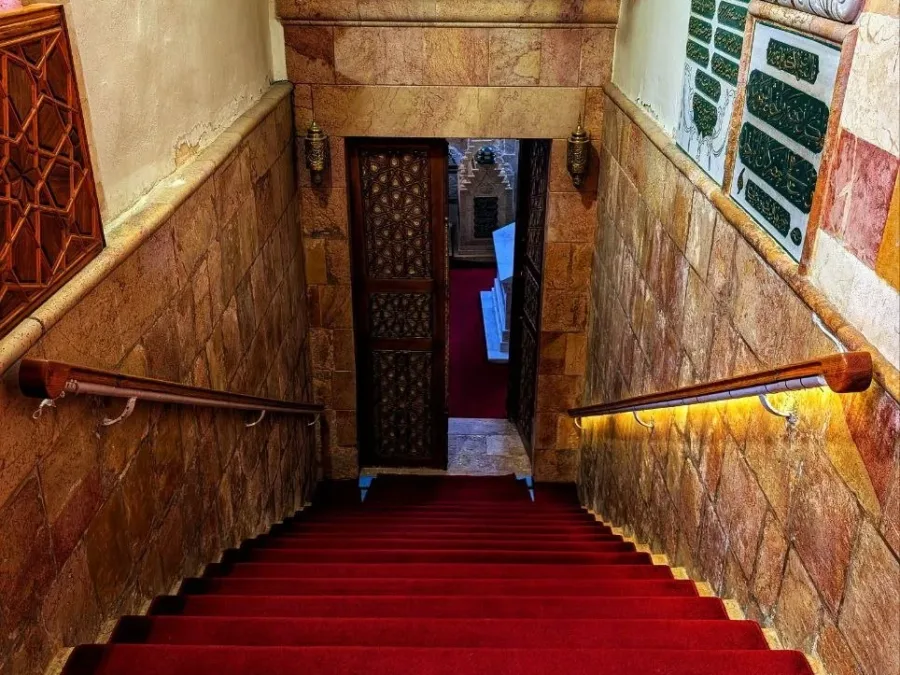
Shaykh Shukri al-Luhafi died on the 18th of July 2015, at the age of 95. His funeral prayer was held in the Umayyad Mosque, and the gathering that came to it was very large. He was buried in the al-Najibiyya cemetery, near the al-Nuriyya al-Kubra school and close to the grave of Nur al-Din Mahmud Zanki. His grave is visited by people who still take something from the way he lived.